The Challenge
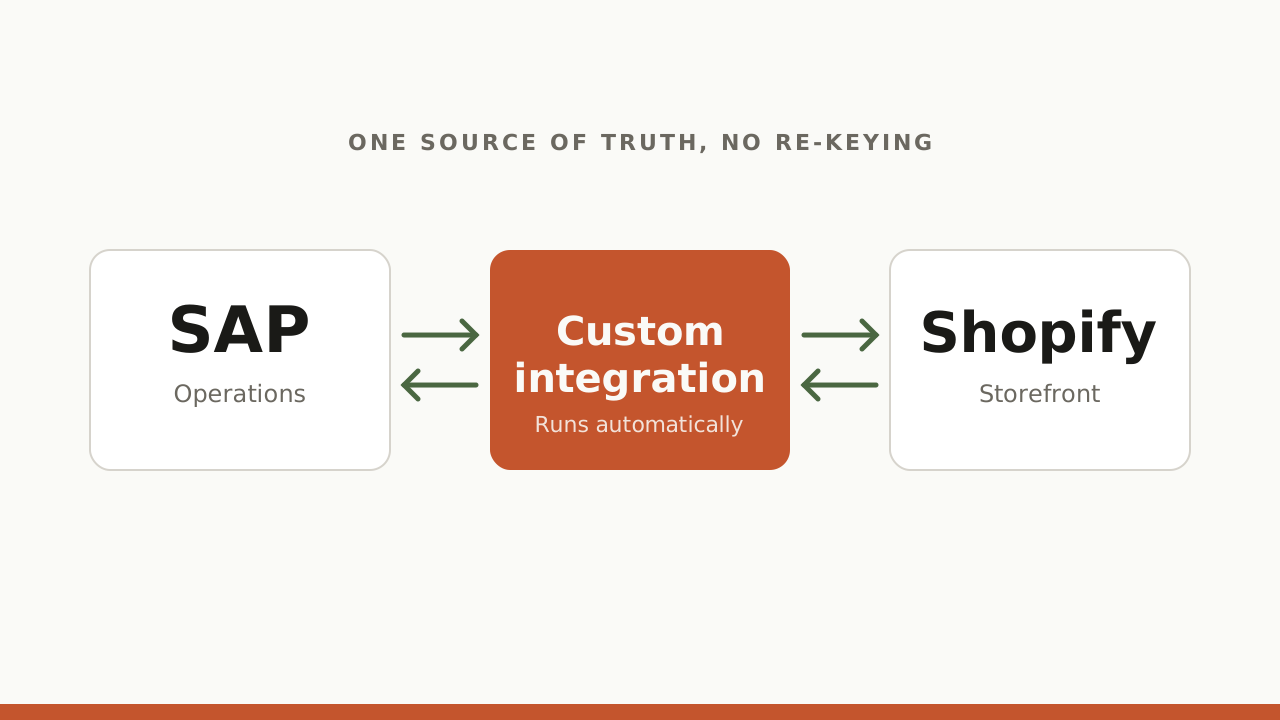
Bont makes some of the most technically advanced cycling shoes in the world, sold through several online stores: consumer and wholesale, cycling and rowing, in Australia and overseas. Behind the scenes, the business runs on SAP, the system it uses to manage stock, orders and accounts (often called an ERP).
Two capable systems that don’t talk to each other create a quiet tax: someone has to be the bridge. Every order placed online had to be retyped into SAP by hand. Customers had to be looked up or created. Tax and exchange rates had to be worked out for overseas orders. Payments had to be recorded. It wasn’t hard work, but it never stopped, and every retyped line was a chance for a mistake.
The Approach
I’ve worked with Bont for several years, building the Shopify side of the business. So before connecting anything, I already knew how orders, dealers and customers moved through the stores. I mapped how each of those then moved into SAP, where the hand-offs were, and which ones cost the most time or carried the most risk.
Two decisions shaped everything:
- Make it hard to lose an order. Orders that can’t go through straight away wait and try again. Problems are collected into a short list for a person, not an inbox full of alerts.
- Keep people in charge of the risky parts. New wholesale accounts and anything that has already shipped go to a person to approve. Everything routine runs on its own.
It was also switched on store by store, so each one was proven before the next went live.
The Solution
A custom connection, built for Bont, that sends every online order into SAP within minutes:
- No retyping: orders from all of Bont’s stores arrive in SAP automatically
- The right customer, every time: existing customers are matched, new ones are created, and the customer record is shared back to the store
- Tax and currency sorted: GST is handled correctly, and overseas orders use the right exchange rate for the day
- Changes follow the order: if a customer’s address or order is changed after they’ve paid, the change carries through while the order is still open. Anything already on its way goes to a person
- Payments recorded: incoming payments are matched up automatically instead of being keyed in by finance
- Mistakes caught early: duplicates are prevented, totals are checked against what the customer paid, and orders wait until the warehouse is ready
- A simple dashboard: staff see what’s come through, what needs attention, and can retry or resolve a problem in a click
The Shopify tools I’ve built for Bont over the years sit alongside it, and the business now depends on them every day:
- MyBonts: customers design their own shoes online, then save, share and preview them, all the way through to the order
- Dealer applications: one form takes a new dealer from application to approved account, in place of three disconnected tools
- Warranty claims: customers and dealers submit a claim with photos, and the team reviews it in one place
- Shipping quotes at checkout, staged payments on large wholesale orders, and scheduled reports across every store
- Sizing help so riders pick the right pair
The Result
Roughly three hours a day came back to the team, which adds up to around 750 hours across a working year. That time now goes into running the business instead of moving data between systems.
The SAP connection has been running for a month. The Shopify tools have been in daily use for years, including the reporting and dealer functions the team relies on.